In 2025, Edge AI has officially moved from buzzword to backbone technology. With the rise of ultra-fast 5G/6G networks, efficient on-device processors, and privacy-first workflows, companies are shifting intelligence from the cloud to the edge—right where data is created.
From factories and hospitals to retail brands and logistics companies, real-time AI at the edge is reshaping how teams work, make decisions, and automate operations.
In this guide, we’ll explore what Edge AI is, why it’s booming in 2025, and how businesses are leveraging it to improve speed, security, efficiency, and innovation.
⭐ What Is Edge AI? (Simple Definition)
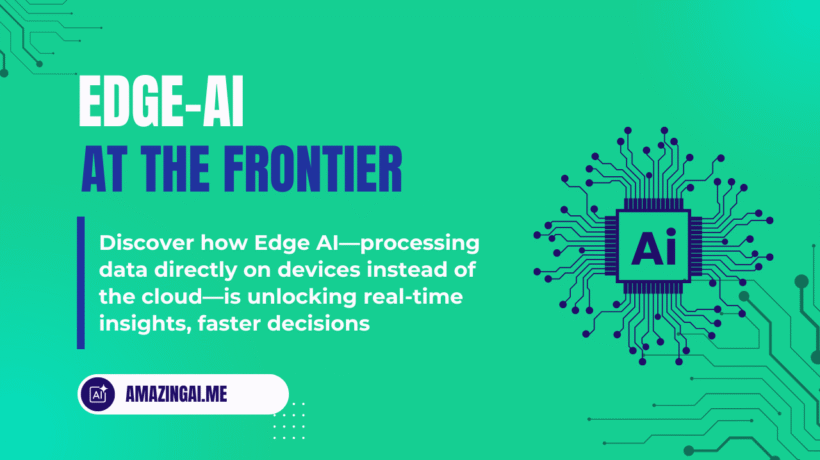
Edge AI refers to running artificial intelligence models directly on local devices—phones, sensors, cameras, wearables, vehicles, and IoT gateways—instead of sending all data to the cloud.
This enables:
- Instant decision-making with near-zero latency
- Greater privacy and data control
- Faster automation
- Offline capabilities
- Lower cloud costs
In 2025, advancements in AI accelerators, TinyML, on-device LLMs, and lightweight transformer models make edge intelligence more powerful than ever.
⭐ Why Edge AI Is Exploding in 2025
Several technology and market shifts have converged:
🔸 1. On-Device LLMs Are Now Practical
Efficient models like Gemma, Llama Edge, GPT-Mini, and TensorRT-LLM can run inside:
- Smartphones
- AR/VR headsets
- Routers
- In-vehicle computers
- Industrial IoT devices
This means real-time transcription, anomaly detection, summarization, and analytics can happen without the cloud.
🔸 2. 6G & Wi-Fi 7 Reduce Cloud Dependency
Next-gen connectivity reduces bottlenecks but also makes edge-to-edge communication smoother for:
- Smart factories
- Autonomous robots
- Fleet management
🔸 3. New Data Privacy Regulations
Governments in the EU, India, and the US now enforce stricter data governance.
Edge AI helps companies comply because data stays local.
🔸 4. Rising Cloud Costs
Companies are optimizing infrastructure.
Running AI on the edge drastically reduces:
- Cloud storage fees
- Compute hours
- Bandwidth consumption
🔸 5. The Workplace Has Become Hyper-Real-Time
Workers expect instant insights—whether they’re remote technicians, drivers, medical staff, or retail managers.
⭐ How Edge AI Is Transforming Workflows in 2025
🔹 1. Manufacturing: Predictive & Autonomous Factories
Edge-powered systems help factories:
- Detect defects instantly
- Predict equipment failure
- Optimize energy usage
- Automate safety compliance
Example:
Cameras analyze product quality at microsecond speeds, stopping faulty batches before they reach packaging.
🔹 2. Healthcare: Smart Devices & Patient Monitoring
Hospitals use on-device AI for:
- Real-time vitals monitoring
- AI-powered ultrasound on handheld devices
- Privacy-first diagnostics
- Offline emergency tools
Doctors can diagnose faster because analysis happens right next to the patient.
🔹 3. Retail: Intelligent Storefronts & Dynamic Pricing
Edge AI enables:
- Footfall analysis
- Behavior-driven merchandising
- Theft detection without cloud latency
- Smart shelves with real-time stock monitoring
This reduces operational overhead while boosting customer experience.
🔹 4. Transportation & Logistics: Safer and Smarter Mobility
Fleet systems use edge intelligence for:
- Route optimization
- Driver behavior monitoring
- Real-time vehicle diagnostics
- Autonomous deliveries
Delivery companies save fuel and reduce delays through continuous micro-adjustments powered by Edge AI.
🔹 5. Smart Cities: Adaptive Infrastructure
Governments implement edge intelligence in:
- Traffic lights
- Waste management sensors
- Public safety cameras
- Environmental monitoring
Cities become more efficient, responsive, and sustainable.
⭐ Real-Time AI: The Core Advantage
Edge AI brings sub-10ms latency, enabling entirely new categories of real-time applications:
| Use Case | Benefit |
|---|---|
| Video analytics | Immediate threat detection |
| Industrial robotics | Precise motion control |
| AR/VR | Zero-lag interaction |
| Energy systems | Instant load balancing |
| Wearables | On-device health alerts |
In 2025, workflows across industries rely on speed, and Edge AI delivers exactly that.
⭐ Cloud vs Edge: Do Companies Still Need Both?
Yes. The future is Hybrid AI.
- Edge handles real-time inference.
- Cloud manages large model training, updates, and long-term analytics.
This balance keeps infrastructure optimized while enabling massive scalability.
⭐ Top Edge AI Technologies to Watch in 2025
- NVIDIA Jetson Orin Nano & Orin NX
- Apple Neural Engine (ANE) upgrades
- Qualcomm Snapdragon X Elite (on-device AI PCs)
- Google Edge TPU Gen-2
- Samsung Exynos NPU
- TinyML frameworks (uTensor, Edge Impulse, TensorFlow Lite Micro)
- On-device LLMs (Gemma 2, Llama Edge, OpenAI Edge models)
These innovations enable more powerful offline and near-device intelligence.
⭐ Challenges Companies Still Face
Even in 2025, Edge AI comes with hurdles:
- Hardware constraints
- Model compression & quantization challenges
- Security at the device level
- Complex distributed infrastructure
- Skilled talent shortage
Businesses must plan hybrid architectures and long-term ML operations (MLOps).
⭐ Future Outlook: The Next 5 Years of Edge AI
By 2030, experts predict:
- 90% of enterprise AI inference will run on edge devices
- LLMs will become standard in cars, wearables, home appliances, and factory sensors
- Edge devices will collaborate in mesh networks for shared intelligence
- Federated learning will ensure data security at scale
Edge AI won’t just enhance workflows—it will redefine how businesses operate.
⭐ Conclusion: Edge AI Is the New Competitive Advantage
In 2025, the world is shifting from centralized cloud computing to distributed real-time intelligence.
Companies adopting Edge AI are experiencing:
✔ Faster decisions
✔ Greater automation
✔ Reduced operational costs
✔ Higher data security
✔ Better customer experience
Whether you’re a startup or an enterprise, building Edge-AI-enabled workflows is no longer optional—it’s the key to staying competitive.